Bible Reading Guide (CEV Edition only)
The Bible is harder to read than a typical book, so there are many Bible reading guides. I offer some on this web page. The images can be copied, pasted, resized to suit, and printed. The pdfs can be downloaded and printed.
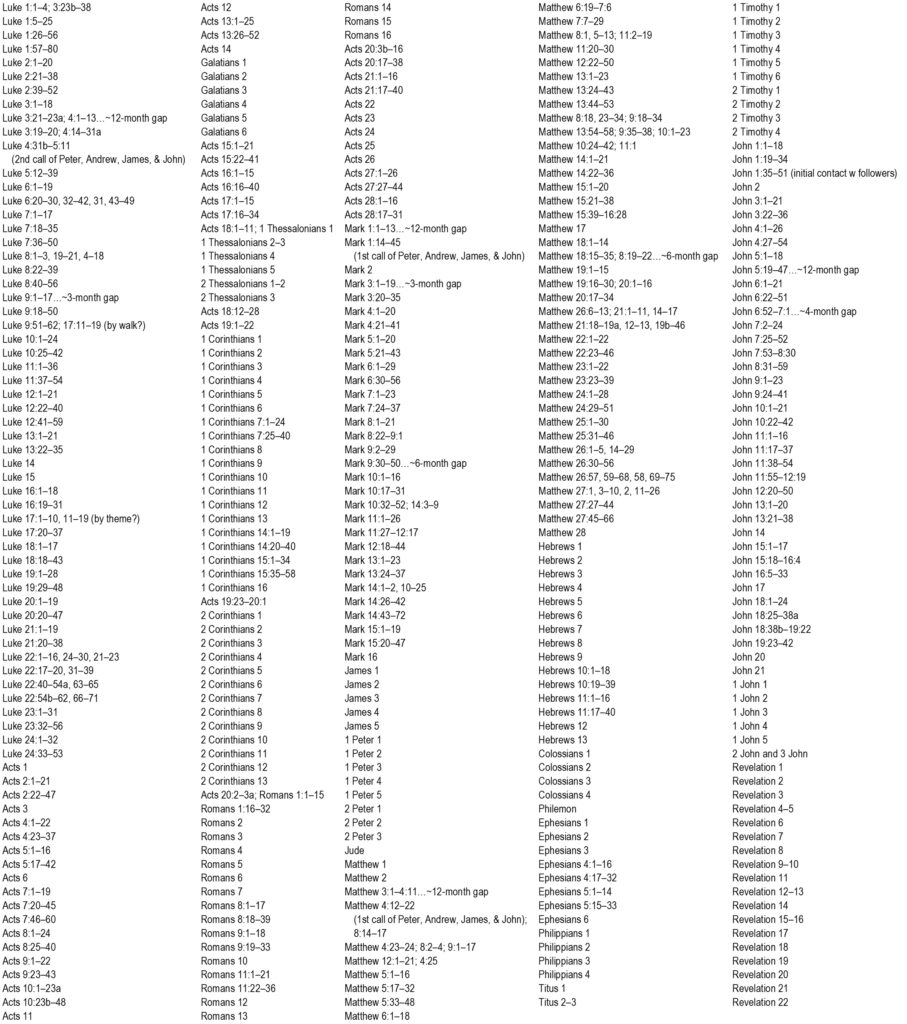
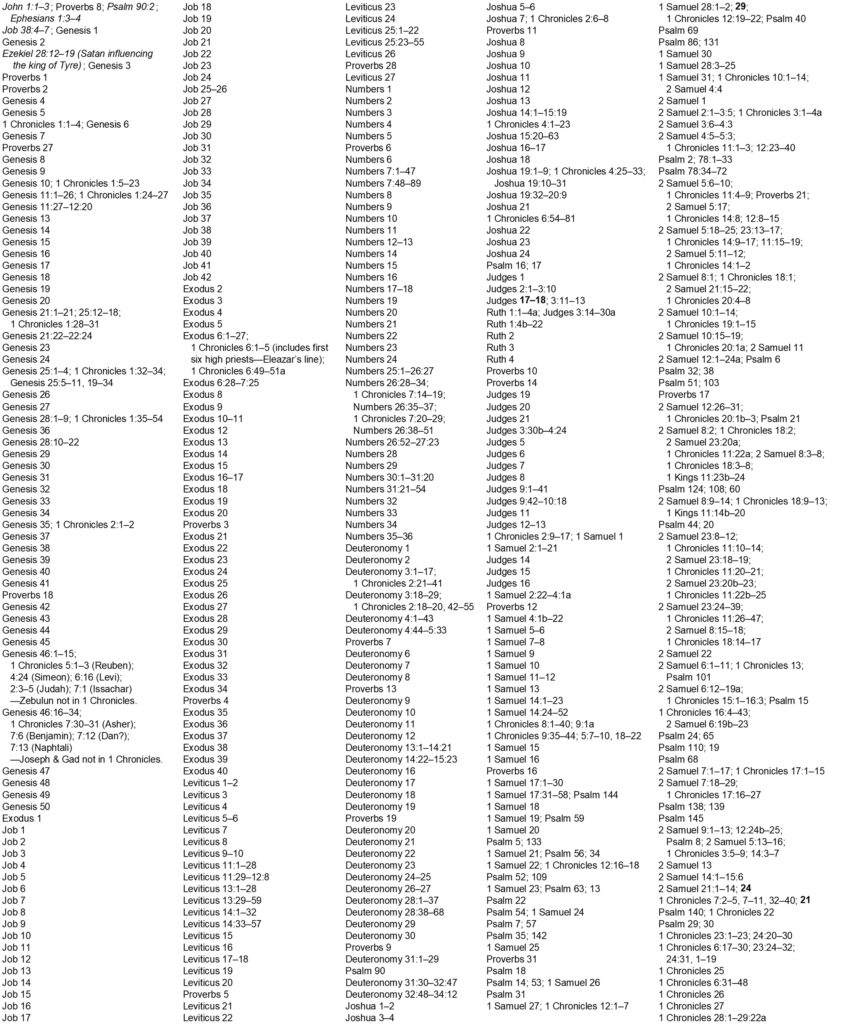
- I have broken the NT into 242 (or 364) readings and the OT into 728 readings. If you had one reading a day from each, you would read through the NT in eight months (or one year) and the OT in two years. The average number of NT verses per reading is 33 (or 22). The average number of OT verses per reading is 32. Many Bible reading guides take you through the OT in the same time frame as the NT. My slower OT pace is easier to keep up with. It also helps prevent the NT reading from being overshadowed by an OT reading that is three times as large.
- I did not include dates on the reading guide, as a person may read ahead or fall behind, and it can make daily Bible reading more like a daily chore than a daily blessing.
- The books are not in the order in which they appear in the Bible. I attempted to put the OT generally (not perfectly) in the order in which the passages occurred (except for Proverbs, which is sprinkled in). A “perfect” ordering would be too clumsy. A “general” ordering balances sequence with clumsiness. I try to place psalms right after the event that inspired the psalm. This keeps you from reading 150 psalms in a row. I try to place the prophets in the reigns of the kings during which they prophesied. I divide the descendants in 1 Chronicles into groups (not verses) and place them in earlier OT books in the “area” where they apply. I placed Job just after Genesis, as I suspect he lived between Joseph and Moses. There will be places where I am wrong. For the NT, if you read the books in order, then when you finish with John, you’re out of the Gospels for a long time. The same thing is true if you harmonized the four Gospels, like I did the OT. Therefore, I split the NT into four groups:
I. Luke, Acts, and the six Epistles written by Paul during Acts (Luke covers the time just before Jesus was born, so I chose that for the first Gospel. Luke also wrote Acts, and I placed Paul’s six Epistles written during the period of Acts at the time they were written).
II. Mark, James, 1 and 2 Peter, Jude (these have a similar style).
III. Matthew, Hebrews (the audience for each was Jews), and the seven epistles written by Paul in the period of Acts 28:30–31.
IV. John; 1, 2, and 3 John; and Revelation (John wrote all of these).
The longest time out of the Gospels is now shorter. Within each Gospel, I put texts in order of time (as I see it… I put Luke 17:11–19 in two places, one based upon time, and one based upon theme – which is where Luke placed it). I did not put the texts in order in the book of Revelation. It is a vision of themes presented in progressive parallelism (overlapping cycles describing the church age [primarily], crescendoing to the age to come). The reading guide simply puts the chapters of Revelation in order.
New Testament (in 242 readings):
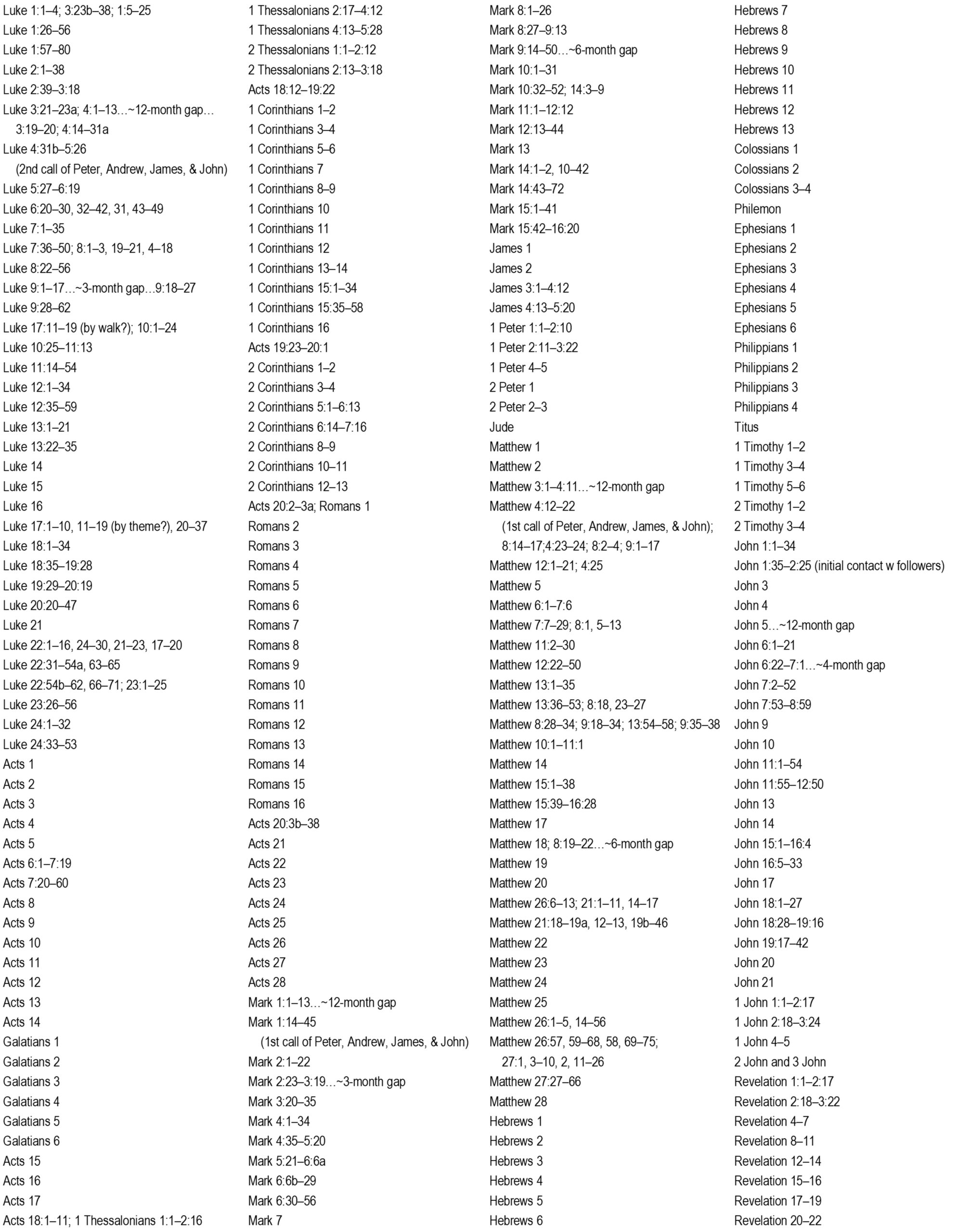
New Testament (in 364 readings):
Old Testament
Book Errata:
1) page 194, next to last row: 1 Samuel 28:1–2; 29; 1 Chronicles 12:19–22; Psalm 40 – bold emphasizes a whole chapter
2) page 195, rows 15 and 16: 2 Samuel 10:15–19; 1 Chronicles 20:1a; 2 Samuel 11 – should be one day’s reading (i.e., in one cell)
3) page 202, row 8: Psalm 75; 76 should be written as Psalm 75–76 – for reference consistency (though they mean the same thing)
4) page 207 row 20: Psalm 113;–115 should be written as Psalm 113–115 – the semi-colon is superfluous
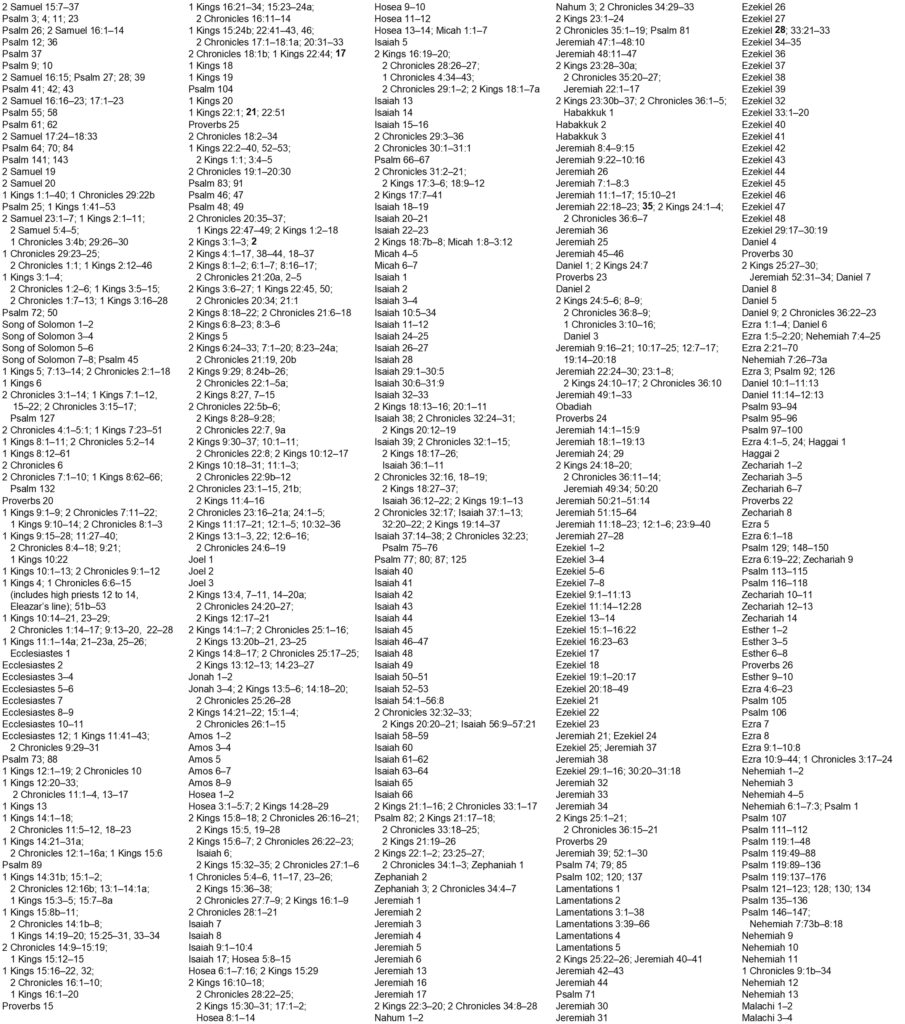
Old Testament (in 728 readings – 2 images – the images have the errata above applied)
Italics = New Testament, or Old Testament duplicated reference
Bold = whole chapter (used for clarity when the reference sequence is complex, as in errata #1 above)
Indented references are a continuation of the reference above (component(s) of one reading – would be in the same cell in the book):
Additional guides found in the CEV edition
Last Supper Harmony:
No erratum discovered yet
The Miracles of Jesus in the Gospels:
No erratum discovered yet
The Discourses of Jesus in the Gospels:
No erratum discovered yet
The Parables and Allegories of Jesus:
No erratum discovered yet
Parables and allegories
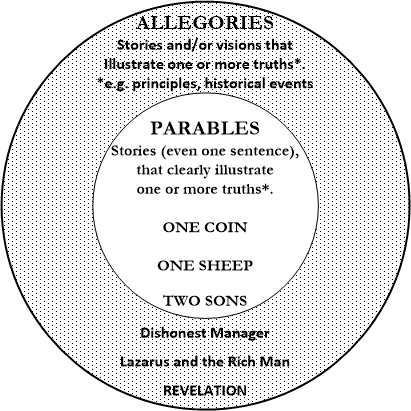
Parables are stories, as small as one sentence, that clearly illustrate one or more truths. Allegories are a broader category. They are stories, or even visions, that illustrate one or more truths, clearly or dimly. Parables are simple allegories. These styles are for visualizing truths, not introducing new truths. They should not set the boundaries of the teaching of God’s Word.